I Am Taxi Driver
- 4.7
- Rating
- 5.00M
- Installs
- Free
- Price

 Analysis by App-foxy
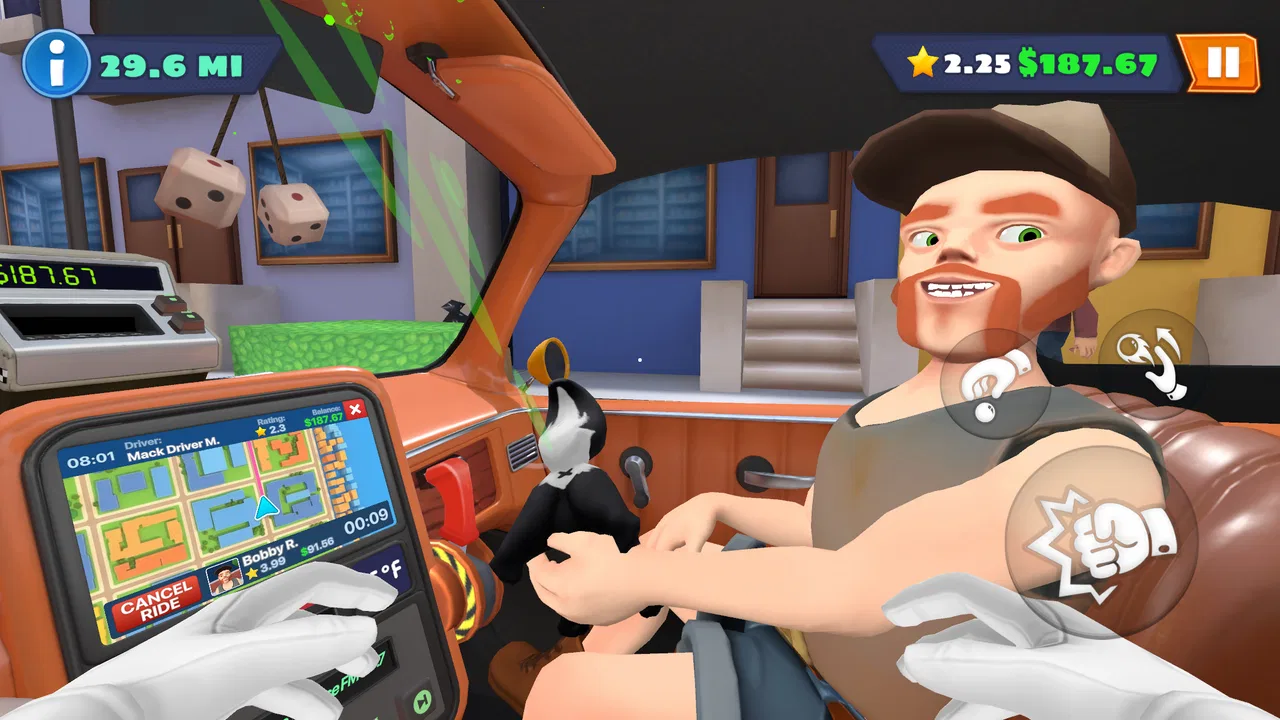
I Am Taxi Driver takes a simple role-playing idea and turns it into a test of attention: I pick up passengers, drive them through a changing situation, and react when an ordinary fare becomes something much less predictable. That central ability is what makes the game appealing. It is not just about moving from one point to another; it is about managing the pressure created by passengers, traffic-like problems, and the strange events that can interrupt a routine trip.
After spending time with it, I found the game easiest to enjoy in short sessions. The premise is immediately understandable, the tone is playful, and the taxi setting gives every task a clear purpose. Estoty has built the experience around the fantasy of being behind the wheel while dealing with whatever the next passenger brings. For players who like light role-playing games with an unusual job-based theme, this free title is easy to try and quick to understand.
Why passenger handling is the game’s real hook
The most important capability here is not simply driving. It is responding to passengers while keeping the trip moving. That distinction matters because it gives the game its personality. In a typical driving game, the road is the main challenge. In I Am Taxi Driver, the passenger is part of the challenge, and the ride becomes a small scenario rather than a silent journey between two locations.
You May Also Like

 Blood Strike: 2.5 Anniversary
Blood Strike’s Loadouts Turn Every Drop Into a Tactical Gamble
A close look at Blood Strike’s custom loadouts: how fast access to signature weapons reshapes its battle royale rhythm, rewards preparation, and narrows the gap between fights.

 Pandora - Music & Podcasts
Pandora’s Music Is Easy to Start, but Harder to Recover
Pandora’s strength is its low-effort path from a seed to a station. Its weak spot is how much confidence it asks you to place in connection, setup, and quiet recovery.

 8 Ball Pool
 Is Built on Rivalries, Rematches, and Routine
A close look at the rivalries, rematches, shared routines, and unanswered safety questions that turn a quick pool match into a persistent mobile community.

 Samsung Music
’s Quiet Strength Is Playing What You Already Own
Its reach comes less from spectacle than from dependable access to a personal library. That simplicity is both the app’s strongest retention engine and its ceiling.

 AccuWeather: Weather Radar
AccuWeather Review: A Quick, Clear Forecast for Everyday Decisions
For everyday plans, the best forecast is the one you can understand quickly. AccuWeather makes rain timing, radar, and local conditions easy to act on, with a few trade-offs.

 Hill Climb Racing
Why Hill Climb Racing Still Turns Crashes Into One More Run
A tiny car, a bumpy hill and one more upgrade: Hill Climb Racing keeps resurfacing because its simple chaos makes every near-miss feel personal.
More From Our News Desk



I liked this setup because it creates a useful rhythm. I begin with a straightforward job, get a sense of where the passenger needs to go, and then stay alert for the disruption that changes the mood of the ride. The game’s store summary points toward that unexpected madness, but the practical effect is more interesting than the wording suggests: I am encouraged to treat every pickup as an unfolding situation instead of assuming that all fares will feel identical.
This is where the role-playing label makes sense. I am not only controlling movement. I am stepping into a working role and making decisions within that role. The taxi is the setting, but the passenger is the source of context. That makes the game more approachable than a complex driving simulator while giving it more character than a basic point-to-point transport game.
The concept also works well for players who enjoy games built around ordinary activities made unusual. There is a small satisfaction in starting with a familiar service job and then seeing how quickly the situation can become unpredictable. I Am Taxi Driver does not need a grand fantasy world to create variety; it uses the contrast between a normal fare and an abnormal event as its main source of entertainment.
How the central loop feels during play
In practice, I approach each ride as a three-part task. First, I identify the immediate passenger request. Next, I focus on keeping control of the trip while watching for interruptions. Finally, I deal with the new problem rather than treating it as a minor distraction. That last step is the important one. If I only think about reaching a destination, I miss the reason the game exists.
This makes the game feel different from a conventional taxi simulation. A simulation usually asks whether I can drive carefully, follow a route, or manage a vehicle. Here, the question is closer to whether I can stay composed when the job stops being routine. That gives the game a more reactive feel, even though the basic activity remains easy to grasp.
I also found that the passenger-focused design changes how I use my attention. I do not play with the same narrow concentration I would use in a racing game. Instead, I keep part of my focus on what is happening around the fare. That creates a mild tension: moving too quickly can make me overlook the situation, while hesitating too much can make a simple task feel awkward.
A useful way to play is to slow down mentally before starting a new ride. I look at the request, decide what the immediate priority is, and avoid assuming that the first instruction will remain the only concern. This is not a complicated strategy, but it helps because the game rewards awareness more than blind speed. Read the passenger situation before treating the trip as a race.
A realistic short-session use case
Imagine having a few minutes before leaving home or while waiting for an appointment. I Am Taxi Driver fits that moment better than a role-playing game that requires a long uninterrupted session. I can start a ride, respond to the situation around it, and stop after a small piece of progress without needing to remember a complicated storyline or a large collection of systems.
That makes it particularly suitable for casual players who want a game with a clear identity but do not want to study a large rule set. The taxi role provides enough structure to make the session feel purposeful, while the unexpected passenger situations keep it from becoming a repetitive delivery checklist.
It can also work as a relaxed alternative to racing games. If I want movement and quick reactions but do not want constant competition or high-speed lap times, the passenger-centered format offers a gentler kind of pressure. The challenge comes from handling the job rather than beating another driver.
Where the game may frustrate you
The same focus that gives the game its charm can become a limitation. Players who want a deep driving simulator may find the role-playing layer more important than vehicle realism. If your ideal taxi game includes detailed traffic rules, careful fuel planning, extensive vehicle tuning, or a highly realistic city, this is probably not the strongest match. I Am Taxi Driver is built around the passenger situation, not around reproducing every part of professional driving.
It may also feel too light for someone looking for a long, story-heavy role-playing adventure. The job premise is engaging, but the appeal depends on enjoying repeated variations of the same basic responsibility. If you need a large world with elaborate character development, the usual open-world role-playing alternative will offer more depth. The trade-off is that those games demand more time and attention than this one.
Another possible friction point is the unpredictability itself. I enjoy the way a normal fare can become strange, but players who prefer complete control may find that interruptions get in the way of a clean route. The game asks me to accept that the passenger is not just cargo. If I want a calm driving experience where nothing interferes with the route, a straightforward driving or parking game would be a better choice.
The Teen content rating is also worth considering when choosing it for a younger player. That rating places it more naturally with older children, teenagers, and adults than with very young users. I would make the decision based on the individual player’s comfort with the game’s situations and tone rather than assuming that a taxi theme automatically makes it suitable for everyone.
Who benefits most from the passenger-first design
The strongest audience is made up of players who like compact role-playing ideas, humorous unpredictability, and games that can be understood without a long tutorial. I would recommend it to someone who enjoys trying unusual occupations in games, especially when the occupation is only the starting point for unexpected events.
It is also a good fit for players who like making small decisions under changing circumstances. The game does not need a complicated inventory or a huge ability tree to create a sense of involvement. The changing passenger situation gives each ride a reason to pay attention. That is a clever use of theme because the taxi job naturally supports short, self-contained encounters.
Players who prefer racing may still enjoy it if they are willing to trade pure speed for situational awareness. Players who prefer simulation may appreciate the recognizable job setting, although they should approach it as a playful role-playing game rather than a professional driving tool. The best match is someone who wants a little unpredictability without committing to a massive adventure.
I would skip it if my main goal were competitive racing, realistic vehicle handling, or a long campaign with carefully developed characters. I would also skip it if I disliked repeating a familiar activity with different complications. The game’s appeal comes from seeing how the passenger changes the ride; without that interest, the basic taxi framework may not be enough on its own.
How it compares with familiar alternatives
Compared with racing games, I Am Taxi Driver is less concerned with speed and more concerned with context. A racing game gives me a clear opponent, lap, or time target. This game gives me a passenger and a situation. That makes it less exciting for someone chasing adrenaline, but more inviting for someone who wants a story-like reason to keep playing.
Compared with driving simulators, it is more accessible and less technical. I do not approach it expecting a detailed lesson in road discipline or vehicle maintenance. The benefit is that I can concentrate on the unusual passenger encounters. The cost is that players who value realism may see the taxi setting as a backdrop rather than a complete simulation.
Compared with conventional role-playing games, the game has a narrower loop and a more distinctive job fantasy. A traditional role-playing game may offer more exploration, equipment, combat, and character progression. I Am Taxi Driver instead uses the ride itself as the unit of play. That makes it easier to pick up, but it also means I should not expect the breadth of a large adventure.
In my view, this focused design is a strength when I want a quick, unusual experience. It becomes a weakness only when I expect the taxi theme to support a full simulation or a sprawling narrative. Knowing that trade-off before installing it prevents disappointment.
Practical expectations before installing
The game is free, which makes experimentation straightforward. I can try the passenger-focused loop without treating the first session as a major commitment. Its average rating is 4.5 from around 5.7 thousand ratings, and it has passed one million installs, so there is clear interest in the concept beyond a tiny niche audience. Those figures do not replace personal taste, but they suggest that the simple premise has found a receptive audience.
The current version is 1.1.0, and the game was released on February 12, 2026. I mention those details because they help place the review in context: this is a relatively recent title, so I would approach it as a focused experience that may continue to develop rather than as a mature simulation with years of accumulated systems.
One practical question is whether the game is suitable for a quick test. Yes, that is where it makes the best first impression. I would not begin by expecting a long evening of progression. I would play several passenger jobs and ask whether I enjoy the interruptions and role-playing decisions. If the answer is yes, the compact structure becomes an advantage rather than a limitation.
Another question is whether it is better played casually or with full concentration. I found a middle ground works best. It is casual enough for short sessions, but the passenger situations deserve attention. Playing while distracted may make the game feel flatter because the main pleasure comes from noticing how the ride changes.
Small habits that make the rides more enjoyable
My first useful habit is to treat every pickup as a fresh scenario. I avoid carrying assumptions from the previous ride into the next one. That keeps the game’s central surprise effective and stops the activity from becoming an automatic sequence of taps and turns.
My second habit is to separate movement from decision-making. When something unexpected happens, I focus on understanding the new priority before rushing ahead. This simple pause helps me avoid turning a manageable situation into a messy one. The game is more enjoyable when I respond deliberately instead of trying to force every ride into the same pattern.
My third habit is to use the game as a mood-based choice. When I want competition, I choose a racing game. When I want realism, I choose a simulator. When I want a strange little job scenario that can fit into a short break, I choose this one. That is a more accurate description of its strength than calling it a general driving game.
These habits also reveal the main trade-off. The more I engage with the passenger role, the more distinctive the game feels. The more I ignore that role and focus only on transport, the more ordinary it becomes. The experience rewards players who accept its specific idea instead of trying to turn it into something else.
My recommendation for different kinds of players
For a casual Android or iOS player, I think this is an easy game to sample. The free price removes the biggest barrier, the taxi premise is immediately clear, and the passenger situations give the short sessions a reason to continue. I would recommend it to friends who want something lighter than a full role-playing adventure but more characterful than a basic driving challenge.
For a dedicated role-playing fan, my recommendation is more conditional. Try it if you enjoy unusual settings and compact scenarios. Do not choose it as a replacement for a deep fantasy or science-fiction role-playing game. Its value lies in the focused passenger loop, not in the size of its world or the complexity of its character systems.
For a driving enthusiast, I would ask what kind of driving they want. If the answer is realistic handling and technical mastery, another option will probably be better. If the answer is a playful taxi job where the passenger creates the trouble, this game offers a distinctive alternative.
For parents and younger players, the Teen rating deserves attention before installing. The taxi theme may sound harmless, but the game’s appeal comes from dealing with unusual situations, so I would use the age label as a practical guide rather than judging the title only by its vehicle setting.
Final thoughts after living with the taxi role
I Am Taxi Driver works because it understands that picking up a passenger is more interesting when the ride can change unexpectedly. Estoty has chosen one verified capability—the ability to take on passenger jobs and react to the madness around them—and made that the center of the experience rather than burying it beneath unrelated systems.
I appreciate that focus. The game is not the right answer for every driving or role-playing preference, and its narrow loop will not satisfy players demanding realism, competition, or a huge campaign. But for short sessions, unusual job-based play, and light role-playing built around changing situations, it has a clear identity.
My recommendation is to install it when you want a quick game with a recognizable starting point and an unpredictable middle. Begin with an open mind, pay attention to the passenger instead of treating the fare as a delivery marker, and judge the game by that interaction. If that small shift in perspective sounds entertaining, I Am Taxi Driver is a worthwhile free download; if you only want fast roads or detailed simulation, your time is better spent elsewhere.
FAQs for I Am Taxi Driver
01What is the main objective of the game 'I Am Taxi Driver'?
The main objective of 'I Am Taxi Driver' is to simulate the experience of being a taxi driver. Players are tasked with picking up passengers and transporting them to their destinations within a set time. The game emphasizes realistic driving physics, navigation, and time management to earn fares and tips.
02Is 'I Am Taxi Driver' suitable for all age groups?
While 'I Am Taxi Driver' is designed to be accessible, it's best suited for players aged 12 and up due to its realistic driving simulation and mild in-game language. The game does not contain any graphic content, but younger players might find the driving mechanics challenging.
03Does the game require an internet connection to play?
No, 'I Am Taxi Driver' can be played offline, making it convenient for users without constant internet access. However, certain features like leaderboards and updates might require a connection. Playing offline allows users to enjoy the core gameplay without interruptions.
04Are there in-app purchases in 'I Am Taxi Driver'?
Yes, 'I Am Taxi Driver' includes in-app purchases. Players can buy additional vehicles, upgrades, and customization options. While the game is free to download, these purchases can enhance the gameplay experience, although they are not necessary to progress.
05What kind of graphics and controls can players expect?
Players can expect high-quality graphics that closely mimic real urban environments, enhancing the immersive experience. The game offers intuitive controls, including steering wheel and pedal simulations. Customizable settings allow users to choose between tilt, touch, or controller input to suit their preferences.
Pros
- Realistic city driving experience
- Intuitive controls and navigation
- Various missions add variety
- High-quality graphics and sound
- Customizable taxi options
Cons
- In-app purchases can be pricey
- Occasional in-game ads
- Limited offline features
- Some missions feel repetitive
- Battery drain on older devices

I Am Taxi Driver
Gallery